

The Treatment Of Cross Addicition In Rehabs
Cross addiction is a complicated topic. Here is a guide of all you need to know about cross addiction, in just six minutes reading time.
You can prevent cross addiction.
Cross addiction or Addiction Interaction Disorder is commonly seen in rehabs and clinical practices. Cross addiction is the transfer of addiction from one substance to another; and/or the exchange of addictive behaviours. If you already have an alcohol or drug addiction, you are more prone to developing a cross addiction. However, cross addiction is preventable and treatment in rehabs will help you achieve and sustain a healthy and balanced life.
Rehabs will address the burden of harm of your addiction
Addiction means using drugs, or engaging in behaviour despite the potential for personal problems, harm and negative consequences. For example, you may have an addiction if you continue to gamble after you can no longer pay your debts, you lose your possessions or damage significant relationships. You may want to stop your addiction but are unable to do so on your own because you are addicted. Treatment in rehabs will help you to come to terms with the damages of your addiction to yourself and others.
Addiction rehabs’ estimation of demographics
In 2016, 3 million people died because of the detrimental use of alcohol. This means that alcohol causes more than 5% of the global disease burden. In other words, alcohol causes 1 in 20 deaths, with men accounting for more than three quarters of these deaths.
How do rehabs understand cross addiction?
Rehabs treat drug addictions and addictive behaviour, such as gambling, sex, food and spending, to name a few. People with alcohol addiction are 18 times more likely to report prescription drug abuse than those who do not drink. This is what cross addiction is. Other examples of cross addictions include addicts to swap Valium for alcohol, alcohol for gambling and high-risk sports for cocaine.
Substance Use disorders and gambling in rehabs
The rate of pathological gambling is much higher among those with substance use disorders, and vice versa. In fact, those with substance use disorders are four to five times more likely to engage in pathological gambling, than those of the general public. Of note, gaming and pornography addiction is becoming increasingly prevalent in today’s culture.
What happens when you exchange one chemical for another?
Treatment in rehabs will educate you on cross addiction. In rehabs, we explain that cross addiction can be compared to you moving between cabins on the Titanic. The chemical and/or addictive behaviour is different, but the process remains the same: a sinking ship. In rehabs, we will help you learn and understand what happens when substitution occurs. You will either develop a new addiction, or the substitute addiction will make you relapse on your drug of choice.
Addressing cross addiction and denial in rehabs

In rehabs, we understand that total abstinence is very difficult to accept. The thought of facing the realities of life without the anaesthetising effects of chemicals may be terrifying. Subsequently, you may develop rationalisations and excuses to deny your addiction. The two most common rationalisations addressed in rehabs are:
- The theory of relativity: To consider some drugs as harmful and others as safe.
- “It’s okay because my doctor prescribed it:” To choose to believe that medication prescribed by a doctor can’t harm you.
The thin shaving of truth embedded within the denial shades us from the cross-addictive nature of our condition.
The rehabs guide to behavioural addictions
A holistic approach to your treatment process in rehabs will be essential to your recovery. While individual and group therapies are critical to your process, most rehabs will incorporate the Twelve Step Programmes of Alcoholics Anonymous (AA) and/ or Narcotics Anonymous (NA) in their treatment models. Similarly, the treatment of behavioural addictions in rehabs requires participation in focused Twelve Step groups, such as Gamblers Anonymous (GA), Eating Disorders Anonymous (EDA) or Over eaters Anonymous (OA) and Sex and Love Addicts Anonymous (SLAA).
Forms of Cross Addiction
Rehab professionals have identified the most common forms of cross addictions. Here are some of them listed below in more detail:
Other Drugs:
- The most prevalent form of cross addiction involves the addiction to multiple substances. Addicts often use different substances to fill the void left when they stop using their real drug of choice.
Gambling:
- Pathological gamblers most commonly abuse alcohol.
- The enmeshed relationship between gambling and substance addiction perpetuates the cross-addiction cycle:

Compulsive Sexual Behaviour:
- Statistically, sexual disorders are more prevalent in men than women.
- The pattern of addictive sexual disorders is similar to substance addiction. It is characterised by continued sexual activity despite the damaging effects of these behaviours.
- Substance abuse, mental health disorders and situational triggers can cause hyper-arousal and compulsive sexual behaviour. However, in recovery, sexual disorders develop when compulsive sexual behaviour is used to replace substance abuse.
Pornography:
- Viewing pornography and chronic masturbation are common cross addictive behaviours.
- The addiction to pornography activates the dopamine system in a manner similar to drugs and alcohol.
Shopping:
- Excessive spending and shopping is often used as a means to self-medicate anxiety and depression.
- Compulsive shoppers experience a ‘high’ when making purchases, which is the heart of their addiction.
- Compulsive shopping usually leads to mounting financial debt and stress. This, in turn, worsens the substance use disorders and co-occurring mental health conditions as the person struggles to cope.
Food:
- Eating disordered behaviour is another common form of cross addiction. In particular, sugar releases dopamine which may fuel addiction.
Many more cross addictions exist and can be addressed in treatment. Fortunately, rehab can help you! Rehabs offer treatment to these addictions as well as other impulse control disorders.
How does cross addiction occur?
Obtaining treatment in rehabs and recovery is an awesome first step but it does present a new problem. How do you face reality without drugs and/ or alcohol when you still desire that feeling? The brain releases a feel good chemical, dopamine, in response to anything that is pleasurable. Those suffering from addiction desire that response and so develop craving, prompting relapse. You may bargain with your addiction: I can’t use my favourite drug, but maybe it’s okay to try something else. Since you are using a different drug to the original one, you may think that you can control your using. However, this is never the case. Your addiction will eventually demand complete satisfaction. With time, an addictive pattern similar or identical to the original pattern develops and cross addiction will form.
You don’t necessarily need to use drugs in order to take drugs. In rehab you will learn that certain behaviours are potentially addictive while others are not. We will help you identify your unique pattern in this cycle at Rustenburg Addiction Care.

For more information on the dopamine reward system, please click here.
The treatment of cross addiction in rehabs.
Importantly, cross addiction does not necessarily have to be a progression from one addiction directly to another. There can often be years of sobriety or non-addictive behaviours between the addictions. Some addictive behaviour, like gambling, can be eliminated completely, while others will require the identification of your ‘sober point.’ Your sober point will help you be aware of cross addictive behaviours.
Addressing Cross addiction and co-occurring conditions in rehabs
If needs be, we will address your underlying and co-occurring mental health conditions in rehab, which can cause multiple addictions. An integrated approach that addresses the addiction and co-occurring disorders simultaneously is thought to be the most effective way to assist people in treatment rehabs towards recovery.
Cognitive Behavioural Therapy (CBT) is an internationally recognised treatment that is used in individual and group therapy. CBT allows for the exploration of dysfunctional thought patterns, feelings and behaviours which drive the addiction cycle.
Treatment modalities for cross addiction in rehabs.
Health and counselling professionals use CBT in rehabs to treat addiction and cross addiction. Cognitive behavioural therapists target negative automatic thoughts which stem from mistaken beliefs, self-doubt and fear.
During active addiction, it is often these very thoughts and feelings that are self-medicated through substance misuse.
The key areas of focus in addiction treatment are to:
- Identify and redefine negative thoughts, beliefs and insecurities that maintain substance abuse.
- Provide self-help tools and positive behaviours to replace drug or alcohol use.
- Teach effective communication skills.
Rehabs guide to self-reflection in cross addiction
In rehabs, cross addiction treatment requires dedicated and focused attention. During the first treatment of your primary addiction, your addiction counsellor will help you identify what aspects of your life contributed to you using substances, and how you lost of control over your drug or alcohol use.
Openness and honesty is crucial
It becomes more challenging to determine why you developed a cross addiction once you are in recovery, and your initial treatment in rehabs is completed. You will need to be open and honest about the reasons that lead to your cross addiction:
- Did you not fully recover from your first addiction?
- Are there other reasons that led to your cross addiction that you did not disclose in your first treatment?
- Are your surroundings not supportive of your recovery?
- Is there a relationship in your life, old or new, that is interfering with your ability to recover from addiction?
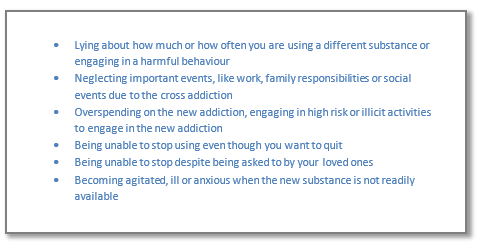
Warning signs of cross addiction
During your treatment of addiction, rehabs will also dedicate time to assist you with formulating your personal recovery plan. It is important to be mindful of the following warning signs in recovery so that you may seek help.
Keep yourself safe and avoid cross addiction.
Rehabs will provide you with the best way to identify, address and avoid cross addiction through educating you and others. Limiting triggers for relapse and harmful behaviours remains crucial to maintaining sobriety and avoiding self-destructive behaviours. Here are a few ways to do that:
- Identify your high-risk situations. The 3-circle exercise is a helpful tool in recognising triggers for relapse and personal risky behaviours.
- Take an inventory of behaviours you may be doing to create a cross addiction. Uncontrolled gambling, shopping, eating, internet porn and other behaviours are important changes that signal the need for help.
- Use the 5 pillars of recovery and stay connected to your network of support. Meetings, Sponsor, Service, Step Work and Higher Power. Reach out to professionals for counselling and support in stressful times or when experiencing thoughts of relapse.
- Be open to the feedback of friends and family and seek help.
These are a few self-destructive behaviours to look out for:
If you or a loved one needs help battling a cross addiction, Rustenburg Addiction Care can help! Contact us for more information on the next steps on the path to recovery.