

Psychotherapy and Alcohol Rehabilitation at Cape Town Rehabilitation Centres
The two most common therapeutic approaches to alcohol rehabilitation are:
- Cognitive Behavioural Therapy (CBT)
- Dialectical Behavioural Therapy (DBT)
Overall, this article will give you all you need to know about Cognitive Behavioural Therapy (CBT), and Dialectical Behavioural Therapy (DBT), in relation to alcohol rehabilitation.
What is Cognitive Behavioural Therapy?
Essentially, CBT is based on the idea that feelings and behaviours are caused by a person’s thoughts, rather than external things like people, situations and events. While you may not always be able to change your circumstances, you can change what you think about them. This helps you to change how you feel and behave.
Cognitive Behavioural Therapy is a structured and problem-focused therapy that is highly effective in treating mental health issues, including addiction. CBT therapists view mental health problems as exaggerations of normal processes that largely result from disturbances in our thought processes. Ultimately, CBT is based on the idea that our thoughts, feelings, bodily sensations, and actions are connected and influence each other. This means that how you think affects how you feel and behave and vice versa.
Cognitive-behavioural coping skills treatment is a short-term, focused therapeutic approach to helping alcoholism or drug-dependent clients achieve abstinence and recovery. Therefore, the treatment approach uses the same learning processes you used to develop alcohol dependence in the first place.
CBT in Alcohol Rehabilitation helps to:
- Teach you to recognise situations in which you are most likely to drink alcohol
- Avoid these circumstance where possible
- Cope with other problems and behaviours which may lead to your substance use
According to CBT theory, your interpretation of life events is more important than the actual events themselves. In other words, it is not a particular situation that causes you to feel emotional distress. Instead, it is your interpretation or view of that situation that causes psychological pain and suffering. This is because your thoughts have a powerful effect on your emotions. Rehabs use this to uncover and address the thoughts that cause / trigger your desire to use alcohol.
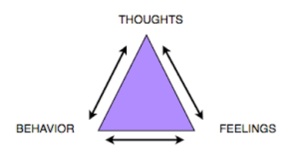
Rehabilitation focuses on addressing how you interpret the situation and therefore how you will feel about it. For example, if you interpret a situation in a neutral or positive light, you will probably feel calm or positive. These feelings will influence how you react. Conversely, if you interpret the same situation negatively, you might experience negative emotions and behave in a different way altogether.
To understand how CBT works it is important to first understand how situations, thoughts, feelings and behaviours are connected.
Example 1:
Imagine you are walking past one of your favourite local bars on your way home from your friend’s house.
The event or situation: You hear people laughing, glasses clinking and music.
Your thought or interpretation: You think you see someone you know sitting in the bar having a drink and you begin to think it wouldn’t be such a bad idea to just have one drink .
Emotional response: Excitement and anxiety builds as you think about that first sip and your heart beats faster.
Behaviour: You start walking towards the bar.
This example highlights the thoughts, feelings and behaviours that rehabilitation examines, processes and changes. Basically, CBT works towards restructuring your thought patterns about alcohol use. It then addresses how to change and interrupt the cycle in order to establish healthier feelings and behaviours.
Example 2:
The same event or situation: Now imagine that you are walking home from your friend’s house. You pass your local bar, hearing the cheerful laughter, music and the clinking of glasses.
Your thought or interpretation: You take a closer look and think that the bar is filled with strangers, that you are not thirsty, and don’t really feel like a drink.
Emotional response: You feel calm and relaxed.
Behaviour: You carry on walking home.
These examples show how rehabilitation and CBT can help you to be able to experience the same situation totally differently because of the way you interpret it. In other words, CBT helps you to process the meaning you give to your experiences (your interpretation). And in turn, how this largely determines your feelings about the events in your life. We are all constantly interpreting what is going on around us. We form beliefs about ourselves and others, as well as the world we live in. Sometimes these beliefs are inaccurate and distressing and can lead to unhelpful ways of behaving.
Alcohol rehabilitation helps you to choose alternative ways of thinking and behaving:
CBT sessions will encourage you to explore different ways of thinking and behaving while working through your rehabilitation program. You will develop new skills to regulate your mood, manage symptoms and improve relationships. CBT ultimately guides you to become more effective in your journey to recovery by helping you to:
- Set realistic goals
- Learn how to solve problems effectively
- Learn how to manage stress and anxiety through relaxation techniques, coping self-talk and behaviour experiments
- Identify triggering situations
- Identify and challenge negative thoughts and beliefs
- Keep track of feelings, thoughts and behaviours to make it easier to identify and change them
- Identify and engage in enjoyable activities

What is Dialectical Behaviour Therapy and how is it useful in Alcohol Rehabilitation?
Dialectical Behaviour Therapy (DBT) is a treatment that was created by Marsha Linehan. Similar to CBT, DBT helps people learn to manage their overwhelming emotions and cravings in more effective ways. It is effective in helping people learn to handle distress in healthier ways without losing control. This is one of the main reasons DBT is so effective in helping people with addiction.
What exactly is Dialectical Behaviour Therapy?
DBT is a type of cognitive behavioural therapy that focuses on the psychosocial aspects of therapy. In other words, it emphasises the importance of a collaborative relationship. Therefore providing support for the client, and the development of skills for dealing with highly emotional situations.
DBT teaches skills such as mindfulness, distress tolerance, emotion regulation and interpersonal effectiveness. These skills are taught during rehabilitation to assist you in becoming more aware of yourself and your experiences. This increases mindfulness, which in turn, helps you to cope with relationships, cravings and general functioning.
DBT vs. CBT: How do they differ in alcohol rehab?
Although DBT and CBT sound similar, there are distinct features that set them apart. Similarly, DBT, like CBT, focuses on helping people address their dysfunctional thinking and behaviours. They do this by modifying thought patterns, followed by behaviour. However, CBT in rehabilitation is usually confined to a limited period of time and is often applied with one or two specific goals in mind. On the other hand, DBT narrows the focus of rehabilitation to the psychosocial aspects of daily life. While many people experience difficulties with their behaviours and thought patterns, these struggles are often at their most disruptive in the context of relationships with others. Therefore, DBT places emphasis on how you relate to others in your life. Combined with how to understand, regulate and communicate your emotions in an effective and mindful way.
Alcohol Rehabilitation and Observing Urges using DBT
The DBT skills program in rehab focuses on urges and cravings. These are likely to continue for some time after prolonged alcohol abuse or drug use. They can be triggered by certain situations, smell, tastes, moods and so on. While it is useful to learn about these, it is not always possible to avoid triggers or stop them developing. Keeping in mind that having a craving isn’t the same as wanting to use/drink, let alone actually using/drinking. But it is important to attend to a craving to prevent it going further.
DBT programs show you that drug cravings are part of the “what” mindfulness skills. You can compare your urges or craving to:
- Clouds in the sky that fly past
- Boxes coming down a conveyer belt
- Waves that build up, crest, then diminish over time

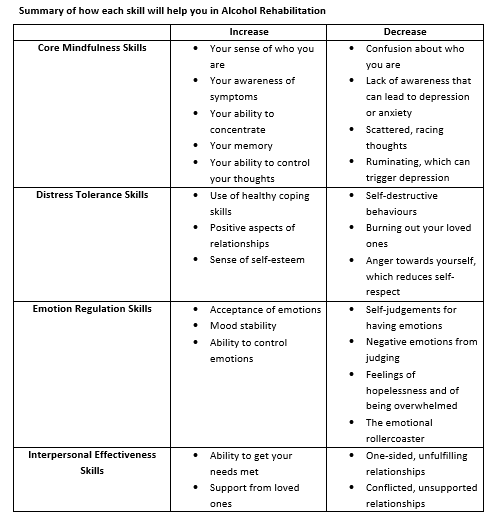
How DBT and Alcohol Rehabilitation works
DBT is a short-term and research-based therapy that helps people manage emotions that may be intense and painful. Often, alcohol is used as a method of coping, or self-medicating, emotions that are difficult, such as anxiety and depression. Rehab centres acknowledge that many people use alcohol to temporarily soothe troubling thoughts as a way to escape from reality. There is often a lot of guilt and shame that accompanies addiction. DBT can help individuals to accept themselves for who they are and move forward in a positive manner. Addiction treatment aims to increase self-acceptance, as this can heighten self-esteem and motivation for positive change.
DBT can help people to recognise intense emotions, how to accept some of them as a part of life, and how to change ones that lead to negative actions. A combination of alcohol rehabilitation and DBT allow individuals to learn how to accept themselves for who they are. These therapies give you the tools for dealing with difficult emotions and managing stress. Painful emotions are part of life. Therapy can help an addict see this and learn to cope with them in a healthier manner.
DBT and CBT are effective therapeutic modalities for alcohol rehabilitation
DBT and CBT are widely used in the treatment of alcohol addiction. They are effective in assisting people along their journey to recovery and a better, more prosperous future. They work by identifying faulty thinking, changing that thinking, in order to change and shift an addicts feelings and behaviours. DBT and CBT are widely researched and acknowledged and have been proven to help with the treatment of alcohol rehabilitation. These practical skills and tools will equip you long after you leave rehab. They are skills that you can always practice in your daily life, allowing you to lead the life you want!
As experts in both forms of therapy, Rustenburg Addiction Care offers world-class treatment for drug and alcohol addiction. If you or a loved one is seeking help for addiction, contact us for more information on the first steps to recovery.